How to Make Plain Congee: Ratios, Stove and Rice Cooker
Introduction
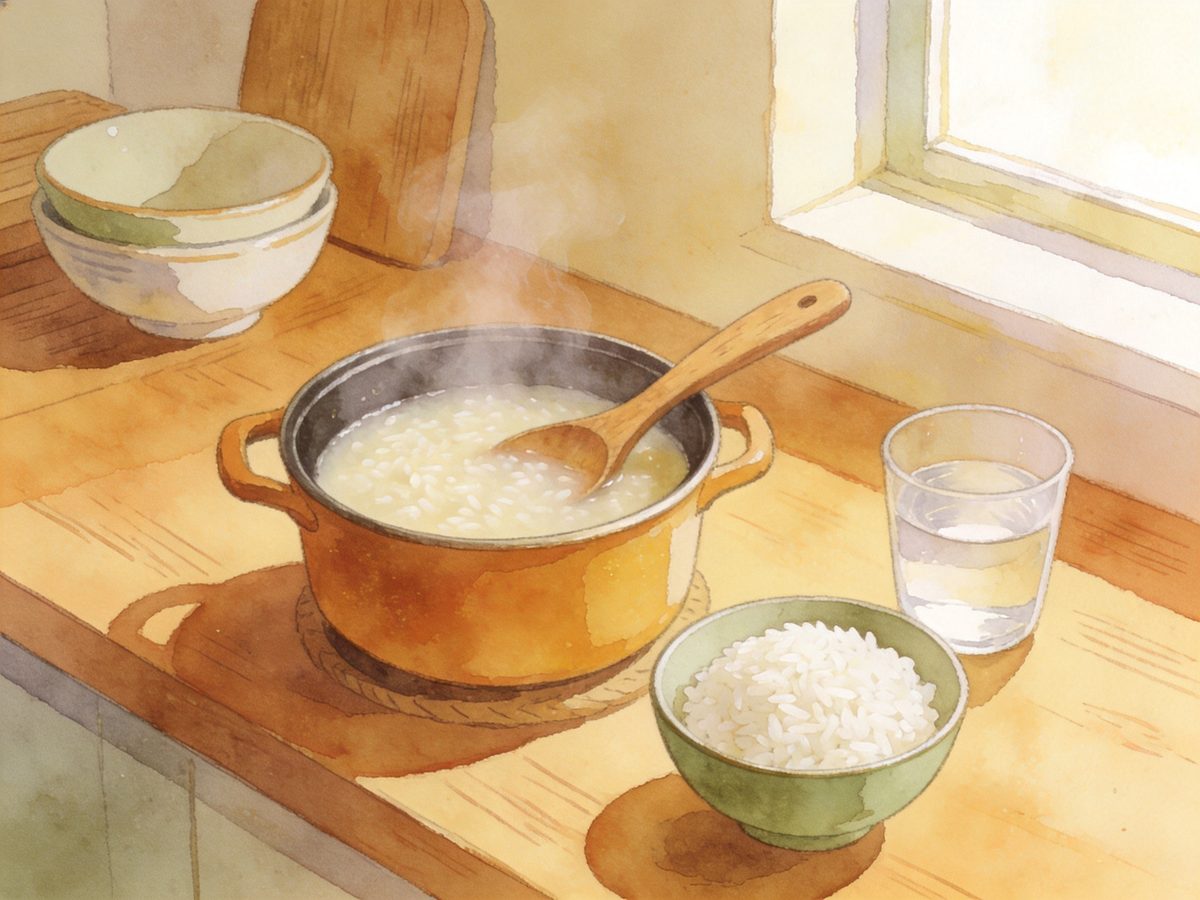
Plain congee is the quiet backbone of Chinese home cooking: rice simmered in plenty of water until it softens into something between soup and porridge. We cover what it is and why it feels comforting in our plain rice congee guide. This article is the practical one — exact ratios, timings for both the stovetop and the rice cooker, and how to rescue the three ways congee usually goes wrong.
No special equipment, no hard-to-find ingredients. If you have rice, water, a pot, and half an hour, you can make congee tonight.
The Ratio: Your One Decision
Congee is only rice and water, so the rice-to-water ratio is the entire recipe. Think of it as a dial between porridge and soup:
- 1 : 6 — thick. Spoonable, like oatmeal. This is the classic breakfast congee.
- 1 : 8 — standard. Soft, loose, flows slowly off the spoon. Start here on your first attempt.
- 1 : 10 to 1 : 12 — loose. Closer to a savoury rice soup; common for sick-day bowls.
In practice: half a cup of rice with 4 cups of water lands near 1 : 8. A little more or less water is not a failure — it is just a different bowl. Some family recipes go even looser; there is no single correct congee.
Two small choices also matter:
- Rice type. Plain white rice — jasmine, long-grain, or short-grain — all work. Short-grain breaks down a little more and gives a silkier bowl.
- Rinsing. Rinse the rice until the water runs mostly clear. It keeps the pot from foaming and the flavour clean.
Method 1: Stovetop (the classic)
- Rinse half a cup of rice until the water runs mostly clear.
- Combine rice and 4 cups of water in a pot — ideally one with a heavy bottom.
- Bring to a boil over medium-high heat, stirring once or twice so nothing sticks.
- Turn down to the lowest simmer, partially cover, and cook 35–45 minutes, stirring every 8–10 minutes, especially near the end.
- Check texture. The grains should have broken down and the mixture should flow slowly. Too thick? Add hot water, a splash at a time. Too loose? Simmer uncovered for a few more minutes.
- Season at the end — a small pinch of salt. Then eat warm.
Total time: about 45 minutes, most of it unhurried. Congee is forgiving; stirring it occasionally is the only real job.
Method 2: Rice Cooker (the set-and-forget)
Most standard rice cookers can make a respectable congee with zero attention:
- Rinse the rice and add it to the bowl with your water at the same 1 : 8 ratio — do not fill above two-thirds, because congee bubbles and can boil over.
- If your cooker has a porridge or congee setting, use it. It usually runs 45–60 minutes.
- If it only has a regular setting, run one normal cycle, then close the lid again and let it sit on keep-warm for another 20–30 minutes; the residual heat finishes the softening.
- Stir, season, and check the texture — add hot water if your cooker runs dry.
Method 3: Speed Version (about 20 minutes)
Short on time? Freeze the rinsed rice first. Frozen rice grains are pre-cracked by ice crystals, so they break down far faster — 20–25 minutes on the stove instead of 40. It sounds like a trick, but it is the difference between "congee night" and "too late for congee."
Fixing the Three Common Failures
- Stuck or scorched bottom — you left it on too high a heat. Keep the simmer gentle, and never scrape the scorched layer into the bowl; transfer the good congee to a clean pot.
- Boiled over — the pot was too full or the heat too lively. Fill pots only two-thirds, and leave the lid ajar.
- Still soupy after a long time — keep simmering uncovered; congee thickens as water leaves. If you are out of time, a lid-off final five minutes does most of the work.
Food Safety, Briefly
- Leftovers: cool, refrigerate within two hours, and eat within a day or two.
- Reheating: bring it back until steaming all the way through, loosening with a splash of water.
- Blood sugar: white rice congee is easy to eat quickly, and readers with diabetes may want smaller portions or a protein topping — the same note our plain congee guide gives.
Once the basic bowl is automatic, the fun starts: try it with a spread of toppings, make it from uncooked rice straight away, or cook a one-pot chicken congee for dinner.
Congee is comfort food and everyday cooking. Nothing in this article is medical advice, and no recipe here treats any condition.