Sweet Congee: Red Bean, Pumpkin and Black Rice Bowls
Introduction
Half the congee pot in a Chinese kitchen has nothing to prove at dinner. It works the breakfast shift, the dessert shift, and — in the case of red bean — the long slow afternoon shift, simmering while the house does other things. This is sweet congee (甜粥): the same rice-and-water patience as the savory bowls, wearing a different wardrobe.
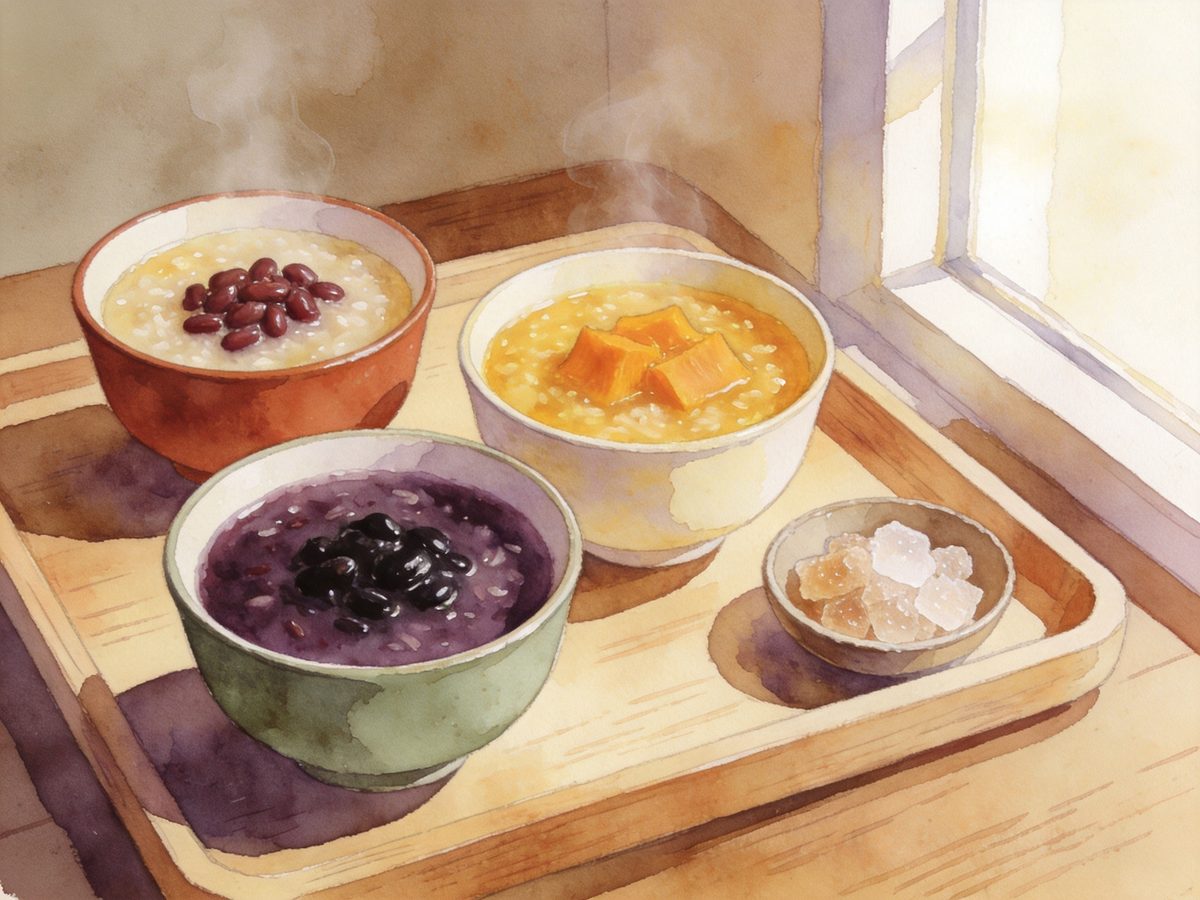
Three bowls cover the whole category: red bean (hong dou zhou, the slow-cooked classic), pumpkin (the thirty-minute weeknight), and black rice (the dramatic purple-black one that tastes like dessert and behaves like breakfast). They share one principle worth stating up front: the sugar goes in late, in small amounts, and tastes like a decision rather than a default.
Bowl 1: Red Bean Congee (Hong Dou Zhou)
The famous one. Adzuki beans (红豆) simmered until they wrinkle and soften, the cooking water turning rust-red and faintly sweet on its own.
Ingredients (4 small bowls):
- ½ cup adzuki beans
- ¼ cup rice (or omit for a bean-forward pot)
- 6 cups water
- 1–2 tbsp rock sugar, to taste
- Optional: a strip of dried tangerine peel, a handful of lotus seeds
Method: Soak the beans 4 hours or overnight (they are small but stubborn). Drain, add with rice and water, bring to a boil, then hold a low simmer 60–75 minutes with the lid ajar, until most beans have split and the liquid is rosy. Add rock sugar in the last 5 minutes, off the main boil. Serve warm; it is also excellent chilled on a summer afternoon, which is how Guangdong does it.
The peel is the quiet upgrade — one strip turns "beans and sugar" into something that smells like a dessert shop.
Bowl 2: Pumpkin Congee (the 30-Minute One)
The weeknight bowl. Pumpkin does the sweetening itself — no added sugar needed, which is why families with small children and grandparents with careful diets both keep it in rotation.
Ingredients (4 bowls):
- ½ cup rice
- 5 cups water
- 300 g pumpkin (kabocha or butternut), peeled, cut into 2 cm chunks
Method: Simmer rice and water as for the plain base. At the 20-minute mark, add the pumpkin; by 30–35 minutes the chunks slough into golden threads and thicken the pot. Stir once or twice near the end, salt optional (a tiny pinch makes the sweetness read sweeter), sugar unnecessary. Done when a spoon leaves a slow trail.
Small upgrade: replace a third of the rice with millet for a looser, nuttier bowl — the classic millet-pumpkin pairing of northern kitchens.
Bowl 3: Black Rice Porridge
Black rice (黑米, sometimes sold as "forbidden rice") is unmilled glutinous rice that cooks to a deep violet-black, with a toasted, almost berry-like sweetness. It is the most dessert-looking bowl on this page.
Ingredients (4 bowls):
- ⅓ cup black rice, rinsed
- ⅙ cup white rice (helps the texture — black rice alone goes gluey)
- 6 cups water
- Rock sugar to taste; optional: a few red dates, a handful of goji berries in the last 5 minutes
Method: Soak the black rice at least 4 hours (overnight better) — it is a whole-grain with an unhurried attitude. Simmer everything except the sugar and goji 50–60 minutes until glossy and purple-black, the colour bleeding through the pot. Sugar and goji at the end. Serve warm; the colour alone sells it.
The Sugar Question, Handled Like an Adult
Three calibrations, and then the pot is yours:
- Timing: sugar added early thickens and stiffens the texture; added in the last 5 minutes it sweetens with less. Late costs nothing.
- Amount: the recipes above land around 1–2 tsp per bowl — noticeably less than dessert-shop versions, which is the point. Sweet congee reads sweetest when the base itself is good.
- Context: readers managing blood sugar — the same portion note our plain congee guide gives applies here, with pumpkin the most forgiving of the three and sweetened red bean the richest. The traditional vocabulary around these bowls (nourishing, warming, "restorative") is cultural description, not physiology — the honest modern framing is: whole ingredients, moderate sugar, actual fruit-and-grain fiber, eaten warm because it feels good.
When Sweet, When Savory
A workable rule from the kitchens this comes from: sweet for breakfast and dessert, savory for the sickbed and the cold evening. The full argument lives in our savory vs sweet congee comparison; the short version is that sweet bowls pair naturally with the morning and with fruit-season, while their savory siblings own the winter nights. Both start from the same pot — the plain base — and diverge at the sugar.
Cooking and culture, not medicine. No bowl here treats any condition — sweet congee's job is to be dessert you don't regret, and it does that job well.