Why Chinese Households Wear Slippers Indoors
Introduction
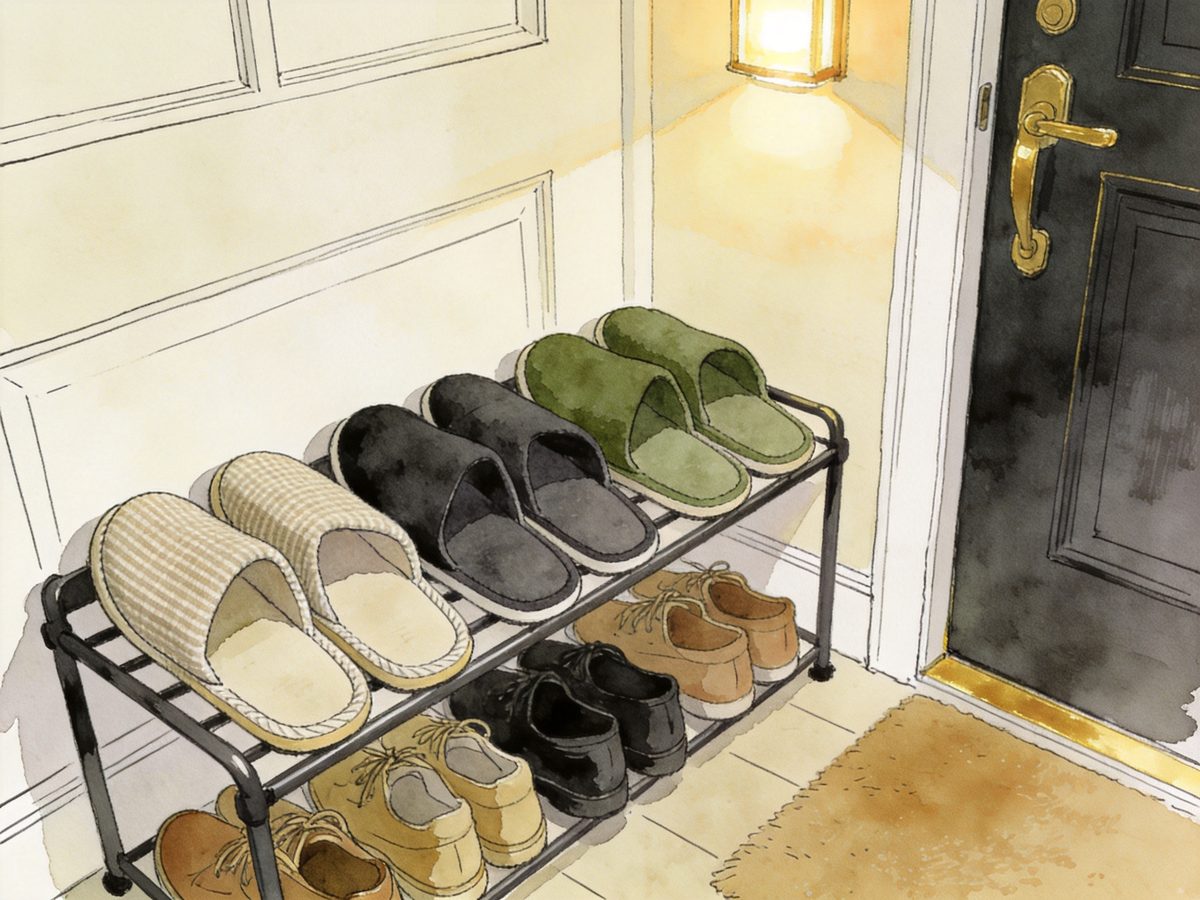
Another quiet detail from the "Becoming Chinese" and "Chinamaxxing" videos: the moment a guest walks in, they are handed a pair of slippers. There is a shoe cabinet by the door, a rack of guest slippers beside it, and often a separate pair for the bathroom. Nobody walks on a bare floor in bare feet — not in January, not in July with the air conditioning blasting.
Western viewers find it charming. Some find it fussy. In China it is neither: it is simply how a home works, and traditional Chinese medicine (TCM) supplies the reasoning underneath.
Here is the full picture — the tradition, the warmth logic, and the very practical reasons this habit, like drinking hot water, survives contact with modern life.
The Tradition: A Line at the Door
The slipper habit is really three habits in one:
- Outdoor shoes stay at the door. Streets, subways, and building lobbies are left outside, along with whatever they carry.
- Every household member has indoor slippers. Often seasonal — cloth pairs for summer, thicker lined ones for winter.
- Guests get their own pair. Keeping a few clean pairs for visitors is basic hospitality, the same way offering a cup of hot tea is.
The hygiene logic is obvious and universal: floors stay cleaner, mopping matters more when feet are clean, and nobody's subway shoes cross the living room rug. Plenty of cultures practice some version of this. What makes the Chinese version distinctive is warmth being treated as equally important as cleanliness.
The Warmth Logic: Cold Comes Up From the Floor
In TCM's way of thinking, cold is something to be managed at the body's boundaries — and two boundaries matter most: the neck and shoulders above, the feet and lower back below. The classic saying is that cold enters where the body meets the world: wind at the neck, and cold rising from the floor through the feet.
Floors are the coldest surface in any home — tile and stone floors in particular, which are exactly what most Chinese apartments are built with. In this framework, keeping the feet warm is not a small comfort detail; it is the daily practice that keeps the "cold invasion" at its main entrance. The same logic keeps babies and toddlers in socks, keeps pregnant women away from bare floors, and explains why the household rule tightens in winter rather than loosening.
You will recognize the pattern by now, because it is the same one behind drying hair before bed: warmth and dryness are treated as the default state of a well-kept body, and every habit nudges in that direction.
What Is Honestly True Here
Fairness to the evidence, as always:
- Cold floors do not cause disease. There is no evidence that bare feet on tile give you arthritis, kidney trouble, or a cold. Colds need viruses; arthritis is not caused by temperature.
- What is true is comfort and circulation. Cold floors genuinely are unpleasant, and cold feet are genuinely distracting at night. Warm feet fall asleep more easily for many people — which is why a hot foot soak before bed is the evening companion habit in the same households.
- The hygiene benefits are real and unglamorous. Less outdoor dirt indoors, cleaner floors, cleaner feet. That alone justifies the habit.
So the honest summary: the traditional reasoning is a framework, not physiology — but the habit it produced is pleasant, cheap, and defensible on hygiene and comfort alone.
How to Try It: The Uncomplicated Version
- Get one pair per person, plus two or three guest pairs. Machine-washable cloth for summer, lined for winter.
- Draw the line at the door. Outdoor shoes off, slippers on — make it automatic rather than negotiable.
- Bathroom slippers stay in the bathroom. This is the detail Chinese households are strictest about, for reasons that become obvious on a wet floor.
- In winter, go thicker rather than hotter. Lined slippers beat walking around in heated rooms with bare feet.
- Wash them like laundry. Slippers only stay hygienic if they actually get washed — the tradition assumes this.
Total setup cost: one trip to the store. Total ongoing effort: none. That is the signature of a habit worth stealing.
The Bigger Picture
Indoor slippers, the after-dinner walk, warm water instead of ice, dry hair before bed — the viral Chinese wellness trend, examined one habit at a time, keeps resolving into the same thing: a household culture that takes warmth, dryness, and rhythm seriously.
None of these habits is a treatment, and none of them needs to be. Their value is that they are easy to repeat — and repeated small comforts, compounded over years, are what the tradition was actually optimizing for.
This article explains cultural traditions for general interest. It is not medical advice, and nothing here diagnoses or treats any condition.