Food as First Medicine: The TCM Idea of Yao Shi Tong Yuan (药食同源)
Introduction
Walk into any Chinese household at lunchtime and you will hear a sentence that has no direct English translation: 这孩子上火了,吃点凉性的 — "this child has too much heat, give him cooling foods." Or its winter cousin: 多喝点姜汤,暖暖胃 — "drink some ginger soup, warm your stomach."
Behind both sentences sits an idea so old and so embedded that most Chinese families never think of it as "a concept": yao shi tong yuan (药食同源) — "medicine and food share the same origin." Food is not just fuel; it is the first, mildest layer of medicine, and the kitchen is the first, gentlest pharmacy. This article explains where the idea comes from, how Chinese food therapy actually sorts and uses foods, what a prevention-minded kitchen looks like in practice, and where the honest limits are. It is cultural and dietary education, not medical advice.
What "Yao Shi Tong Yuan" Means
The phrase pairs two characters you know with two you can guess: yao (药, medicine), shi (食, food), tong (同, same), yuan (源, origin). Together: medicine and food come from the same place and work on the same spectrum.
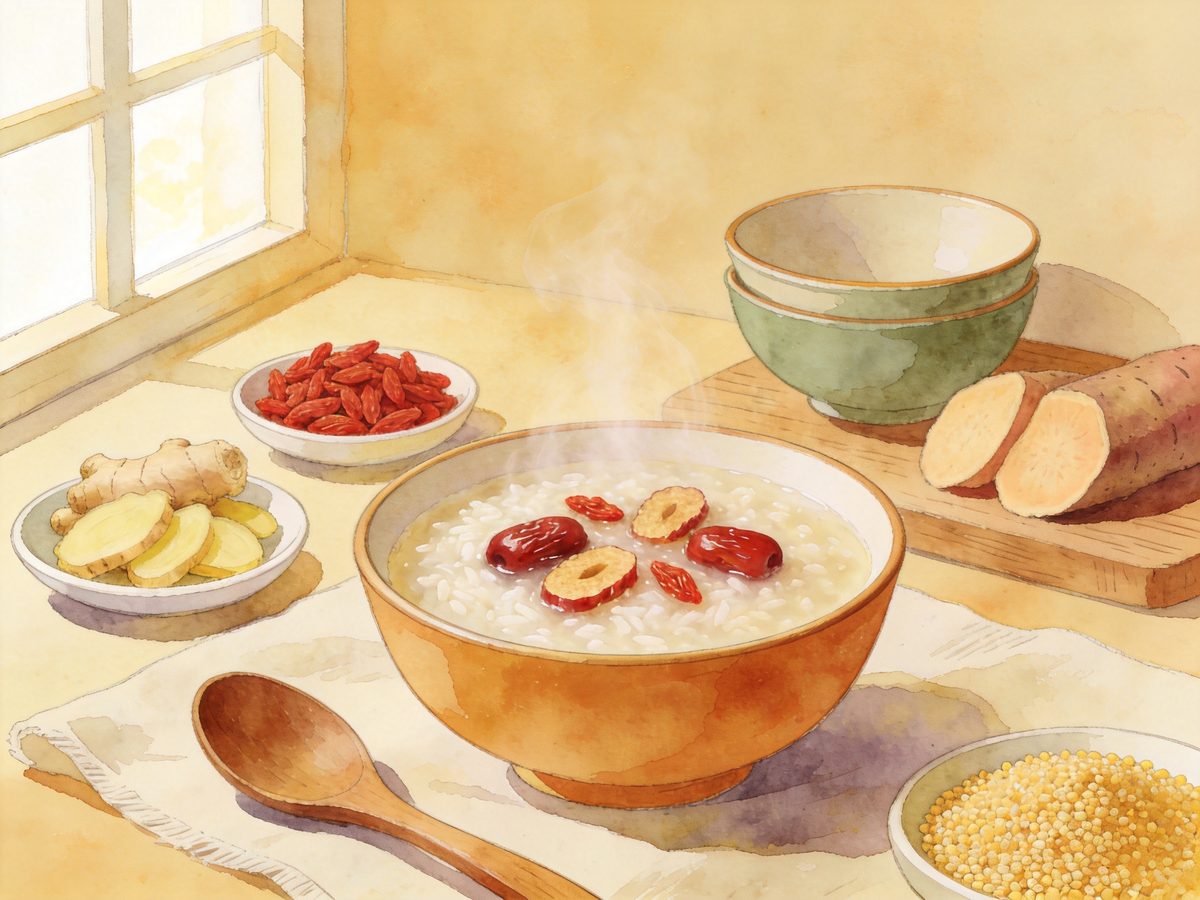
The logic is older than written medicine. In Chinese tradition, early healers sorted everything people ate — roots, grains, fruits, meats — by how it made them feel: this warms, this cools, this dries, this moistens, this settles the stomach, this stirs the gut. The strongest of those became "medicines" (药), used short-term in carefully dosed combinations. The mildest and most everyday became "foods" (食), eaten daily in whatever balance the person needed. Between the two sits a famous middle shelf: yao shi liang yong (药食两用) — items that are officially both, like ginger, goji berries, red dates, Chinese yam, lotus seed, and hawthorn. Walk through a Chinese supermarket and you will see them sold in the grocery aisle and the herbal aisle at the same time.
The practical consequence is a different mental model from the Western one. In the Western frame, food is nutrition (calories, macros, vitamins) and medicine is a separate, reactive intervention for when something is wrong. In the Chinese frame, every meal is already doing some kind of work — warming or cooling, drying or moistening, settling or stimulating — so the only real question is whether it is doing the work you need. A person who always feels cold who eats salads and iced drinks is, in this framework, "dosing" themselves wrong twice a day, the way you might take a sedative to wake up.
This is also why food therapy sits at the first step of the traditional prevention ladder — the philosophy called zhi wei bing (治未病), "treating disease before it starts" (our full explainer walks through its four stages). Food is the mildest, cheapest, most repeated intervention available. Before herbs, before acupuncture, before anything: fix the daily meals.
How Chinese Food Therapy Sorts Food
Chinese food therapy does not sort by calories or vitamins. It sorts foods along a handful of practical axes, learned at the family dinner table:
- Nature (性): warming to cooling. The spectrum every Chinese cook knows. Ginger, scallion, lamb, and longan are warm; mung beans, watermelon, bitter melon, and chrysanthemum are cool; rice, most grains, and apples sit neutral in the middle.
- Flavor (味): five directions. Sour (astringing, traditionally linked to the liver), bitter (clearing, drying), sweet (tonifying, harmonizing), pungent (dispersing, moving), salty (softening, downward). Each flavor is traditionally assigned an affinity with an organ system.
- Function: what it is used for. Warming the middle (ginger), moistening dryness (pear, honey, sesame), strengthening the middle (yam, rice, dates), moving stagnation (hawthorn, tangerine peel), clearing heat (mung bean, chrysanthemum).
- Context: the eater, the season, the climate. The same food is "right" or "wrong" depending on who eats it and when. Cold-nature watermelon is a summer blessing in southern humidity and a questionable choice for a person shivering through a winter flu.
The last axis is the one outsiders miss. Chinese food therapy is not a food list; it is a matching discipline — food matched to person, matched to season, matched to climate. A bowl of mung bean soup is "medicine" in August heat and close to mischief in January.
The classic sorting, compressed:
| Food | TCM nature | Traditional use | Modern kitchen version |
|---|---|---|---|
| Ginger (生姜) | Warm | Disperse cold, warm the stomach | Slices in tea and soups; stir-fry base |
| Red dates (红枣) | Warm to neutral | "Nourish blood," sweeten tonics | Simmered in congee and teas |
| Goji berries (枸杞) | Neutral | Tonify liver and kidney (trad.) | Steeped in water, sprinkled on congee |
| Chinese yam (山药) | Neutral | Strengthen Spleen (trad.) | Steamed, in soups and porridge |
| Pear (梨) | Cool, moistening | Moisten dry throat and cough | Poached or steamed with rock sugar |
| Mung beans (绿豆) | Cool | Clear summer heat | Sweet soup, drunk warm or cool |
| Chrysanthemum (菊花) | Cool | Clear "heat," settle tired eyes | Tea |
| Lotus seed (莲子) | Neutral | Quiet the heart, aid sleep | In soups and sweet congee |
| Hawthorn (山楂) | Warm-ish | Aid digestion of heavy, greasy meals | Dried slices steeped as tea |
| Dried tangerine peel (陈皮) | Warm | Move qi, cut dampness and grease | Aged pieces in soups and tea |
Notice what the table is really saying: the "medicine shelf" of the Chinese kitchen is a spice-and-pantry shelf. Ginger, dates, pear, beans — nothing rare, nothing expensive, nothing that requires a specialist.
Eating for Prevention: What the Practice Looks Like
If medicine and food share one origin, then prevention through food is not a special diet. It is ordinary cooking, done with attention to direction. The traditional kitchen follows a handful of habits:
1. Cook more than you assemble. Raw and cold are, in TCM terms, harder work for the digestive "Spleen." The everyday Chinese pattern — congee, soups, steamed and stir-fried dishes — is warm food three times a day, which the tradition treats as the baseline of digestive health, not a style preference.
2. Match the meal to the season. Winter menus skew warm and nourishing — lamb soups, longan and date teas, root vegetables. Summer menus skew cooling — mung bean soup, winter melon, bitter melon, barely-fried anything. This is the "eating with the seasons" idea taken as a working instruction rather than a farmers-market slogan.
3. Match the meal to the person. The family cook tracks everyone's tendencies: the child who runs hot gets less fried food; the grandmother who always feels cold gets ginger in everything; the teenager who broke out after a barbecue week gets congee and chrysanthemum tea for a few days. Nobody calls this medicine. It is just dinner with feedback.
4. Use the middle shelf deliberately. When something is "off" — a sluggish digestion after a heavy stretch, a dry throat in heating season — the tradition reaches for the food-herb shelf first: pear and rock sugar for the throat, hawthorn tea after the greasy feast, yam congee for the tired stomach. Mild problems, mild tools, repeated for a few days.
5. Watch for the response. The tradition's version of a follow-up visit is the next meal: did the adjustment help? If a "cooling" strategy makes someone feel worse, the conclusion is not "cooling is wrong" but "wrong direction for this person" — and the menu swings warm.
The cumulative effect of these five habits is a kitchen that quietly practices zhi wei bing — treating "the not-yet-ill" — several times a day, at a cost of pennies per meal. That is the economic logic hiding inside the philosophy: the cheapest healthcare in the house is the meal plan.
Where the Honest Limits Are
Yao shi tong yuan is a beautiful organizing idea, and it deserves the same honesty as any tradition:
- Food supports; it does not treat. No congee, tea, or warming soup cures a disease. The tradition's own hierarchy puts food at the mildest end of the intervention spectrum — which is precisely why food is for prevention and support, and anything persistent, worsening, or serious belongs with a clinician.
- The sorting system is traditional, not laboratory. "Warming" and "cooling" are experiential categories from a pre-modern framework. Some of its conclusions rhyme with modern nutrition (more cooked vegetables, fewer ultra-processed fried foods, seasonal variety); the framework itself is a cultural system, not a clinical one.
- Food-herbs are still herbs. Goji, chrysanthemum, licorice, and hawthorn are grocery items in China and bioactive plants in the lab. Anyone on regular medication — blood thinners, blood pressure drugs, diabetes medication — or who is pregnant should treat the herbal shelf with the same caution as any supplement, and mention it to their clinician.
- Direction matters more than intensity. The tradition's most common practical error, in its own telling, is over-correcting: months of "cooling" for a person who runs cold, or endless tonics for someone who needs nothing. Matching, not maximalism, is the skill.
Questions About Food as Medicine
What does yao shi tong yuan mean? It is Chinese (药食同源) for "medicine and food share the same origin" — the foundational idea of Chinese food therapy. Foods and medicines were sorted on one continuous spectrum by how they affect the body: warming, cooling, moistening, drying. The mildest items became everyday food and the strongest became medicine, with an official middle shelf of items that are both, like ginger, goji berries, and red dates. It is the reason a Chinese grandmother treats dinner as a form of gentle healthcare.
What are common food-medicine examples in Chinese kitchens? The everyday middle shelf includes ginger (warming, for cold days and heavy meals), red dates and longan (sweet tonics in congee and teas), goji berries (steeped in water or sprinkled on porridge), Chinese yam (strengthening soups), pear (poached for a dry throat), mung beans (the summer heat-clearing sweet soup), chrysanthemum tea (for "heaty" days), lotus seed (in calming sweet soups), hawthorn (after greasy meals), and aged tangerine peel (in soups to cut grease and dampness). All are inexpensive grocery items rather than rare medicinals.
How is Chinese food therapy different from nutrition science? Nutrition science measures food by composition — calories, macros, vitamins, and their measured effects on the body. Chinese food therapy sorts food by experienced qualities — warming versus cooling, moistening versus drying — and matches them to the person, the season, and the climate. The two overlap more than they clash: the traditional pattern favors cooked meals, variety, moderation, and minimal ultra-processed food, which conventional nutrition also recommends. The traditional framework itself, though, is cultural and experiential rather than laboratory-verified.
Can I practice food therapy at home without buying expensive herbs? Yes — the entire everyday practice runs on pantry-level items: rice and millet for congee, fresh ginger, red dates, goji berries, seasonal vegetables, pears in autumn, mung beans in summer. A "food therapy pantry" costs a few dollars to stock. What matters in the tradition is direction and regularity — warm cooked meals, matched to the season and the eater — not rare ingredients. Expensive tonics are the modern industry's markup on a philosophy that was always cheap.
What should I eat if I always feel cold? The traditional answer is to shift the menu warm: cooked breakfasts like congee or oatmeal instead of cold cereal, ginger and scallion in daily cooking, soups and stews, warming items like red dates and longan, and less iced drinks and raw salad — especially in winter. The tradition also says to keep the neck, abdomen, and ankles warm. If feeling cold is persistent, severe, or comes with weight change, fatigue, or other symptoms, it is worth a medical check-up, since several treatable conditions cause cold intolerance.
Can food replace medicine? No — and the tradition does not claim it can. In the classical hierarchy, food is the mildest intervention, meant for daily maintenance and gentle support; herbs and stronger interventions exist precisely because food is not always enough. Food therapy complements medical care; it never substitutes for it. Persistent symptoms, worsening conditions, and anything serious need a clinician — and anyone on regular medication should check with their doctor before leaning hard on the herbal-food shelf, since some food-herbs interact with common drugs.
Is the idea scientifically supported? The slogan itself is a philosophy, not a testable claim, so it sits outside proof. Its individual ingredients are a mixed, honest picture: some have emerging research (ginger for nausea is well studied; several others are at the "interesting preliminary" stage), and the overall dietary pattern — cooked, varied, moderate, seasonal — matches conventional advice. The traditional categories like "warming" and "cooling" are not laboratory constructs. A sensible modern position uses the pattern for daily habits and keeps medical decisions on medical evidence.