The Kidney in Chinese Medicine: What "Shen" Means (and What It Doesn't)
Introduction
Among all the organ concepts in Traditional Chinese Medicine, the Kidney (肾, shen) has the grandest job description. In TCM theory it stores your inherited essence, governs growth from childhood to old age, anchors the body's warmth, and influences the bones, ears, hair, and reproductive system. Herbal shops sell "kidney tonics" to generation after generation of middle-aged men; beauty influencers recommend "kidney-nourishing black foods" for hair.
But here is the most important sentence in this article: the TCM Kidney is not your anatomical kidneys. It is a functional concept from pre-modern medicine — and confusing the two is where most of the misinformation (and some genuine danger) starts.
This article explains what the TCM Kidney traditionally means, why the concept took that shape, what the food tradition around it looks like, and where the safety lines are. It is wellness education only.
What the TCM "Kidney" Traditionally Governs
In TCM theory, the Kidney system is credited with:
- Storing Jing (精) — essence. The inherited "start-up capital" of the body: it drives growth, development, fertility, and aging. Jing is traditionally described as hard to replenish once spent — which is why the tradition emphasizes conserving it.
- Anchoring the body's warmth and vitality — "Kidney Yang" is the root fire of the body; "Kidney Yin" is its cooling, nourishing half.
- Governing bones, teeth, and hair — traditional texts link Kidney essence to strong bones, lustrous hair, and healthy teeth (and to premature graying or hair loss when essence is said to decline).
- Opening into the ears — declining hearing in old age is traditionally read as declining Kidney essence.
- Supporting water metabolism — the one overlap with the anatomical kidneys, which is why the concepts share a name.
This is why "kidney" talk in Chinese wellness covers such a strange mix of topics: lower back soreness, cold knees and feet, night urination, tinnitus, premature gray hair, low libido, and feeling chronically drained. In TCM's frame, these are all "Kidney" signals; in modern medicine, they are mostly unrelated conditions with unrelated causes.
Why the Concept Is Not Your Anatomical Kidneys
This matters in practice, not just in theory:
- Someone with TCM "Kidney deficiency" (say, chronic fatigue and cold feet) may have perfectly healthy kidneys on a blood test.
- Someone with early kidney disease often has no shanghuo-style symptoms at all — which is why blood pressure checks and blood/urine tests, not tongue observation, are how kidney disease is found.
- Treating "Kidney deficiency" with tonics does nothing for actual kidney disease — and some traditional herbal products have actively harmed real kidneys (more on this below).
Use the tradition for lifestyle framing if you like; use modern screening for your actual kidneys.
The Food Tradition: Black Foods and Winter Eating
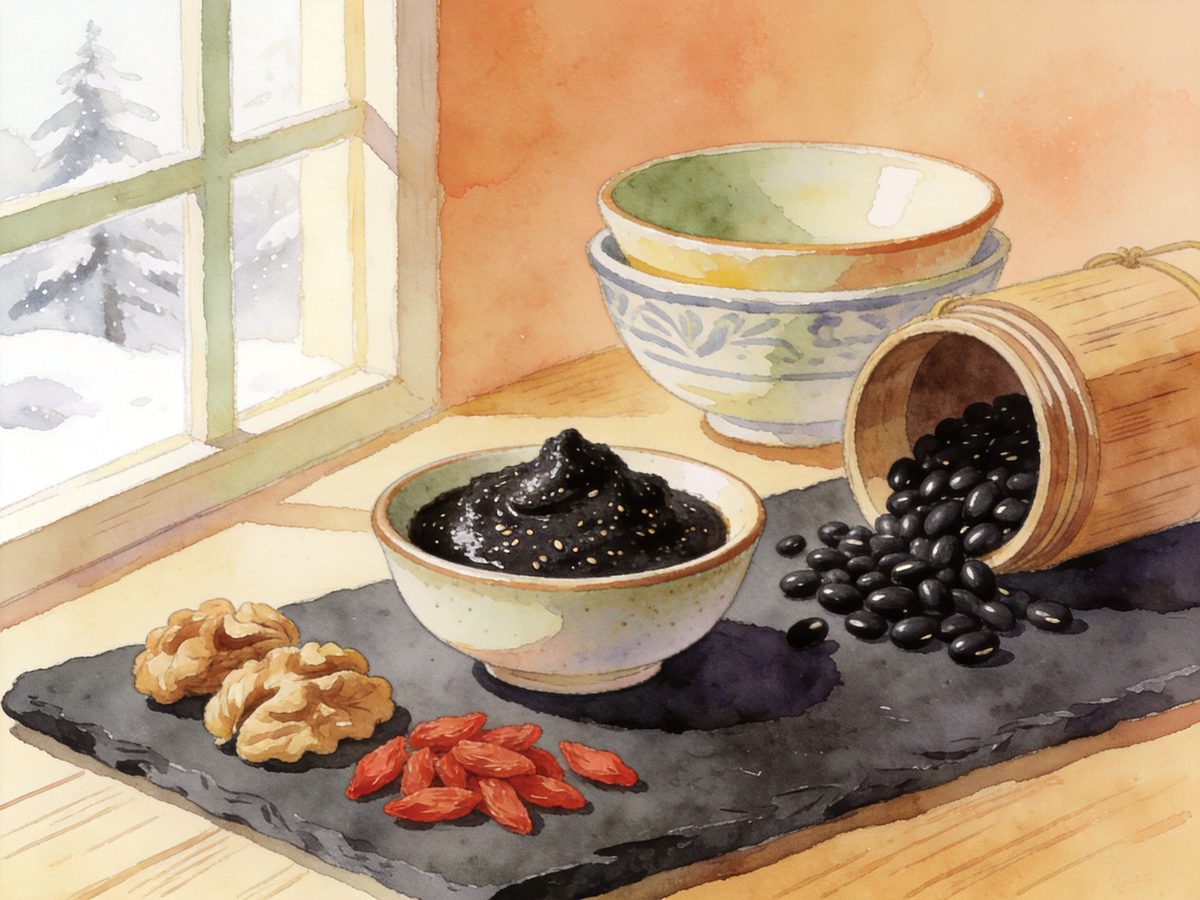
TCM associates the Kidney with the color black, the winter season, and a salty flavor. The classic "kidney-friendly" foods in Chinese dietetics:
- Black sesame — the most famous; traditionally used for hair, bones, and "essence." Ground into porridge, paste, or sprinkled on oatmeal.
- Black beans and black rice — the same "black = Kidney" logic; common in congee and desserts.
- Walnuts — shaped (in the tradition's charming doctrine of signatures) like a small brain, and traditionally paired with Kidney essence, warmth, and longevity.
- Goji berries (gouqi) — traditionally used for Kidney and Liver; the everyday tea-and-congee berry.
- Chestnuts — traditionally described as nourishing Kidney essence, sold roasted on winter street corners across China.
- Warm, slow-cooked winter food — soups and stews with lamb or beef in deep winter are the seasonal expression of "supporting Kidney Yang."
The lifestyle half of the tradition is less about food than about not leaking essence: keeping the lower back, abdomen, and feet warm; sleeping before midnight; moderating sexual activity in the old texts' terms; and avoiding chronic overwork — the state TCM calls draining your essence bank account.
As general lifestyle advice — warm in winter, regular sleep, don't run yourself into the ground, eat walnuts and sesame instead of chips — this is harmless and arguably wise. What it is not is medicine for your kidneys or a fertility treatment.
The Serious Safety Line: Herbal Tonics and Real Kidneys
This section is the reason the article exists:
- Never self-dose "kidney tonic" herbal products if you have kidney disease — or any chronic condition — without telling your doctor. Herbal products are a real medication burden on your actual kidneys.
- Beware unregulated products promising kidney/virility benefits. Some traditional and especially adulterated or imported "kidney strengthening" products have been found to contain aristolochic acid — a compound that causes severe, irreversible kidney failure and urological cancers, and which is banned or restricted in many countries. "Natural" and "traditional" are not safety guarantees.
- Actual kidney disease is silent in early stages. Blood pressure checks, and simple blood and urine tests, are how it is caught. If you have diabetes, hypertension, or a family history of kidney disease, screening matters more than any tonic.
- Low back pain has many causes. Sore lower backs are traditionally "Kidney," but persistent back pain — especially with numbness, weakness, fever, or bladder changes — needs medical evaluation, not sesame porridge.
A Realistic Way to Use the Concept
The healthiest version of "补肾" (supporting the Kidney) in modern life looks like this: sleep like it matters, keep warm in winter, eat real food including the traditional nuts and seeds, pace your work, and get your blood pressure checked. That is the tradition's wisdom with the folklore set aside — and none of it requires a single bottle of tonic pills.