Tinnitus and Chinese Medicine: Can Acupressure Help?
URL slug: /acupressure/tinnitus-chinese-medicine-acupressure/
Primary keyword: tinnitus acupressure
Secondary keywords: tinnitus Chinese medicine, acupressure for tinnitus, ear acupressure tinnitus, ringing ears TCM, tinnitus pressure points, natural tinnitus relief
Meta description: How Traditional Chinese Medicine understands tinnitus, ear-area acupressure points commonly discussed, and what the research says. Educational content only — tinnitus needs proper medical evaluation.
Category: Gentle Acupressure
Risk boundary: Do not claim acupressure treats, cures, or reduces tinnitus. Frame as educational overview of TCM approach. Emphasize that tinnitus is a symptom requiring medical evaluation to rule out serious causes (acoustic neuroma, Meniere's, otosclerosis, etc.).
Introduction
Tinnitus — the perception of ringing, buzzing, hissing, or clicking in the ears without an external source — affects an estimated 10-15% of adults. For some, it is a minor annoyance. For others, it is a life-altering condition that disrupts sleep, concentration, and emotional wellbeing.
Conventional treatments range from hearing aids and sound therapy to cognitive behavioral therapy and medication for underlying causes. But many people also explore complementary approaches — and acupressure is one that comes up often in searches for tinnitus support.
This article explains how Traditional Chinese Medicine (TCM) thinks about tinnitus, which acupressure points are most commonly discussed, and what the evidence actually says. It is for general wellness education only. Acupressure does not treat or cure tinnitus. If you have tinnitus, your first stop should be a medical evaluation — not an acupressure point list.
The Most Important Thing First
Tinnitus is a symptom, not a diagnosis. It can be caused by hearing loss, ear injury, earwax blockage, high blood pressure, certain medications (including some antibiotics, diuretics, and high-dose aspirin), temporomandibular joint (TMJ) disorders, head or neck injuries, acoustic neuroma, Meniere's disease, and more.
Before exploring any complementary approach, you need a medical evaluation to identify or rule out treatable causes. Some causes of tinnitus are reversible if caught early. Others require management to prevent hearing loss from worsening.
Acupressure is not a substitute for this evaluation. If you have tinnitus and have not yet seen a doctor, start there.
The TCM View of Tinnitus
In TCM, tinnitus is not one condition. It is often discussed in terms of two broad categories, distinguished by sound quality, onset, and associated symptoms.
Excess-Type Tinnitus (实证耳鸣)
TCM theory describes this as related to liver fire or liver yang rising — a pattern where heat and upward-rushing energy disturb the ears. It is often associated with:
- Loud, roaring, or high-pitched tinnitus
- Sudden onset
- Irritability, stress, or anger triggering or worsening the sound
- A sensation of fullness or pressure in the ears
- Flushed face, red eyes, bitter taste in the mouth
In TCM reasoning, emotional strain — particularly frustration and suppressed anger — can cause liver qi to stagnate and generate heat. This heat rises along the gallbladder and triple burner meridians (both of which loop around the ears), producing tinnitus.
Deficiency-Type Tinnitus (虚证耳鸣)
This pattern is associated with kidney yin deficiency — a depletion of the body's foundational yin, which in TCM is linked to the aging process, chronic overwork, and constitutional factors. The kidneys are said to "open into the ears" in TCM, so when kidney energy is insufficient, the ears may manifest symptoms. This type is often described as:
- A faint, high-pitched ringing — like cicadas
- Gradual onset, often worsening with age
- Worse at night or when tired
- Better with rest
- Accompanied by other signs TCM associates with kidney deficiency: lower back soreness, weak knees, poor memory, night sweats
These are TCM theoretical frameworks, not medical diagnoses. They are presented to explain how a TCM practitioner thinks about tinnitus — not as a guide for self-diagnosis.
Ear-Area Acupressure Points Discussed in TCM Literature
For educational context, below are the acupressure points most frequently mentioned in TCM discussions of tinnitus. They cluster around the ear itself and the hand. None of them treats tinnitus. They are comfort points — places to apply gentle pressure that some people find soothing.
Around the Ear
SI19 (Tinggong / 听宫 — "Hearing Palace")
- Location: Directly in front of the ear canal opening, in the depression that appears when the mouth is slightly open.
- How to find: Open your mouth slightly. Place your finger just in front of the ear canal entrance. You will feel a small hollow. Close your mouth and the point is still accessible.
- How to press: Use your index finger. Gentle pressure only — the area is sensitive. Hold for 30-60 seconds.
GB2 (Tinghui / 听会 — "Hearing Meeting")
- Location: Just below SI19, in front of the earlobe, in another small depression.
- How to press: Same gentle approach. Use your index finger, 30-60 seconds.
TE17 (Yifeng / 翳风 — "Wind Screen")
- Location: Behind the earlobe, in the depression between the mastoid bone and the back of the jaw.
- How to press: This point often feels quite tender. Use your index finger and press gently, angling slightly forward toward the ear.
GB12 (Wangu / 完骨 — "Mastoid Bone")
- Location: Behind the ear, in the depression just below the mastoid process (the bony bump behind the ear).
- How to press: Often described as the most sensitive local point for tinnitus. Press gently and briefly (30 seconds).
On the Hand
TE3 (Zhongzhu / 中渚)
- Location: On the back of the hand, in the depression between the knuckles of the ring and little fingers, about halfway between the knuckles and the wrist.
- How to press: Use your thumb. Moderate pressure, 1-2 minutes per hand.
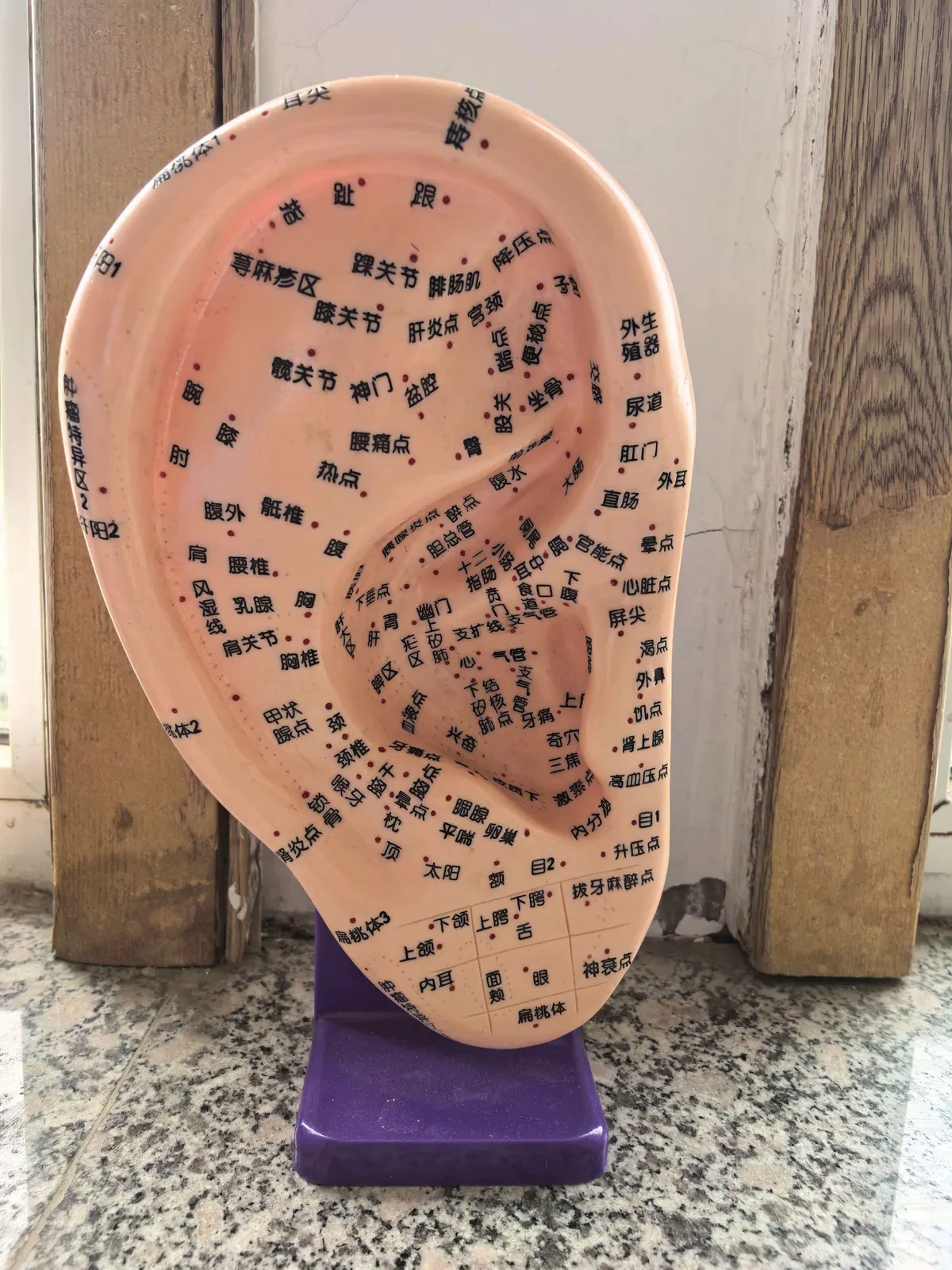
Auricular (Ear) Acupressure
Auricular therapy — using the outer ear as a micro-map of the body — is a distinct tradition that overlaps with but is not identical to TCM. In this system, specific points on the ear correspond to specific body parts and functions. For tinnitus, the ear points most commonly discussed include:
- Kidney point (CO10): Based on the TCM concept that the kidneys open into the ears
- Shenmen (TF4): The general calming point, used because tinnitus can be distressing and stress can worsen tinnitus
- Inner ear point
- Occiput point
Auricular acupressure often uses tiny seeds or beads (traditionally vaccaria seeds, known as wang bu liu xing) taped to the ear at specific points to provide sustained, gentle pressure. This should be done by a trained practitioner — not self-administered based on online instructions.
What the Research Says
Research into acupressure for tinnitus is limited. Key findings:
- Auricular acupressure: Small studies have explored ear seed therapy for tinnitus, with mixed results. Some report modest reductions in tinnitus loudness or distress scores; others find no significant difference compared to control groups. The evidence base is too weak to draw conclusions.
- Combined approaches: Some Chinese clinical studies have examined multi-modal TCM protocols — combining ear acupressure with body acupuncture, herbal medicine, or dietary changes — and reported improvement in a subset of patients. These studies are typically small, not placebo-controlled, and not generalizable.
- Systematic reviews: A 2022 systematic review of acupressure for tinnitus noted that while some individual studies show positive signals, the overall quality of evidence is low. Larger, blinded, controlled trials are needed.
The honest summary: There is not enough high-quality evidence to say whether acupressure helps with tinnitus. Some people anecdotally report relief, particularly from ear-area massage, while others report no benefit. Acupressure may offer comfort and stress reduction — which matters because stress is a known tinnitus amplifier — but it should not be relied upon as a primary treatment.
A Gentle Ear Massage Routine
Rather than focusing on individual points, some people find a general ear-area massage more practical and pleasant. Here is a simple version:
- Warm your hands. Rub your palms together vigorously for 10 seconds until warm.
- Cover your ears. Place your warm palms over both ears with gentle pressure. Hold for 30 seconds. Breathe slowly.
- Rub around the ears. Use your index fingers to make small circles around the perimeter of each ear — in front, behind, above, and below. 30 seconds per ear.
- Press and release. Gently press the tragus (the small flap in front of the ear canal) inward to cover the ear canal, hold for 3 seconds, release. Repeat 5 times.
- End with quiet. Remove your hands and sit quietly for one minute.
This is not a medical treatment. It is a gentle self-massage that some people find calming — and calmness, for many with tinnitus, is its own reward.
When Tinnitus Needs Medical Evaluation
Please see a healthcare professional if:
- Tinnitus starts suddenly, especially in one ear only
- It is accompanied by sudden hearing loss
- It is pulsatile — beats in rhythm with your pulse (this can indicate a vascular cause)
- You also have dizziness, vertigo, or balance problems
- It follows a head or neck injury
- It is significantly affecting your sleep, mood, or quality of life
- You have never had your tinnitus medically evaluated
An ENT (ear, nose, and throat) specialist or audiologist can conduct the appropriate assessments.
Want More Like This?
The book Chinese Wellness Self-Care includes gentle acupressure basics and self-care routines for everyday comfort. It is educational, not diagnostic or prescriptive.
Learn more: /book/
Disclaimer
This article is for general wellness education only. It does not diagnose, treat, cure, or prevent tinnitus, hearing loss, Meniere's disease, or any medical condition. It is not a substitute for professional medical evaluation by an ENT specialist, audiologist, or other qualified healthcare provider. Tinnitus is a symptom that requires medical assessment to identify or rule out underlying causes. If you have tinnitus, seek professional evaluation before exploring complementary approaches.
Editorial Source Notes
- TCM pattern differentiation for tinnitus (excess-type vs deficiency-type, liver fire rising vs kidney yin deficiency) is standard TCM educational content.
- Auricular acupressure point locations and traditional indications are from auricular therapy literature; evidence for tinnitus is limited and inconclusive.
- 2022 systematic review and other research findings are described in general terms; specific study details should be verified in current literature.
- ENT evaluation recommendations and red-flag tinnitus symptoms are from standard clinical audiology and otolaryngology guidelines.