Acupressure for Headache: Where to Press and How Long
URL slug: /acupressure/acupressure-for-headache/
Primary keyword: acupressure for headache
Secondary keywords: headache relief acupressure, pressure points for headaches, LI4 Hegu headache, GB20 Fengchi headache, Yintang headache, natural headache relief
Meta description: Three acupressure points that may help ease headache discomfort, with clear location guides, how long to press, and important safety notes. For general wellness education, not medical treatment.
Category: Gentle Acupressure
Risk boundary: Do not claim acupressure cures or treats headaches. Frame as a comfort practice. Include pregnancy warning for LI4. Emphasize when to seek medical attention for headaches (sudden severe headache, headache with fever/stiff neck/vision changes, etc.).
Introduction
Headaches are one of the most common reasons people reach for a pain reliever. But before you open the medicine cabinet, there is another option worth knowing about — one that requires no pills, no equipment, and nothing to swallow.
Acupressure, the practice of applying gentle finger pressure to specific points on the body, has been used in Traditional Chinese Medicine (TCM) for centuries to help ease head tension and discomfort. While it is not a replacement for medical care, many people find it a useful comfort practice when a headache strikes.
This article introduces three acupressure points commonly associated with headache relief. It is for general wellness education only and does not treat, diagnose, or cure any medical condition.
Safety Notes Before You Start
Please read these before pressing any points.
How to press safely:
- Use the pad of your thumb or index finger — not the nail, not the tip.
- Pressure should feel firm but comfortable. A mild aching or distending sensation is normal. Sharp pain means stop immediately.
- Press for 1 to 2 minutes per point. Longer is not better.
- You can repeat several times throughout the day as needed.
Do not use acupressure unless cleared by a qualified healthcare professional if you:
- Are pregnant — LI4 (Hegu) is traditionally avoided during pregnancy
- Take blood-thinning medication
- Have a bleeding disorder
- Have an injury, wound, rash, or skin infection at the pressure site
- Have a serious medical condition
Stop immediately if you feel dizziness, nausea, worsening pain, or anything that feels wrong.
Seek medical attention if your headache:
- Comes on suddenly and is severe (thunderclap headache)
- Is accompanied by fever, stiff neck, confusion, vision changes, or numbness
- Follows a head injury
- Is getting worse over time or feels different from your usual headaches
- Keeps you from daily activities despite self-care
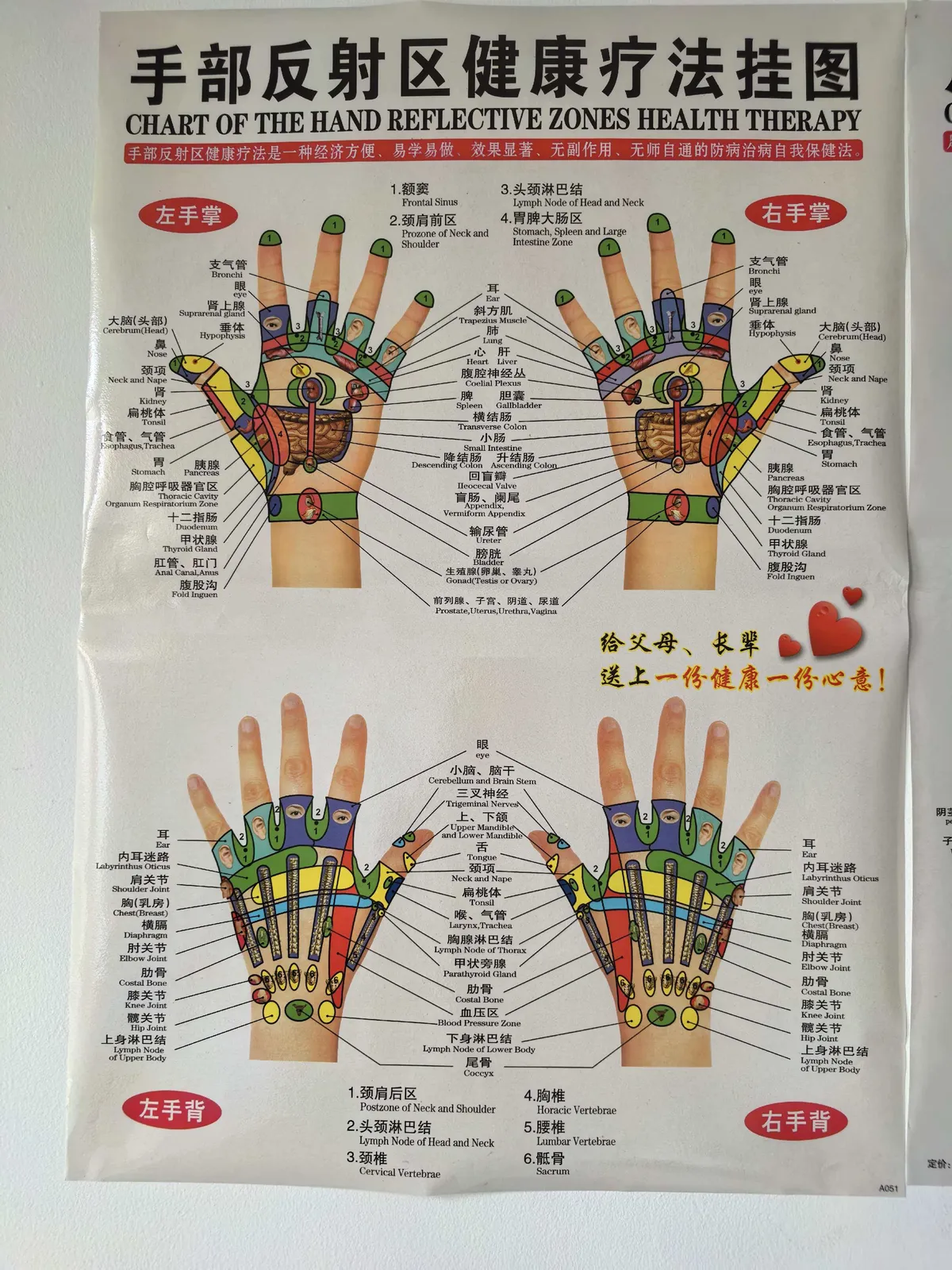
Point 1: LI4 (Hegu) — On the Hand
Hegu (合谷), also known as Large Intestine 4 (LI4), is one of the most widely used acupressure points — not just for headaches, but for general pain relief throughout the upper body.
In TCM theory, the Large Intestine meridian runs from the hand up to the face and head. Stimulating LI4 is thought to influence the flow of qi along this pathway, helping to release tension and discomfort in the head and face.
How to Find It
- Look at the back of your hand.
- Find the highest point of the muscle bulge between your thumb and index finger — the fleshy web where the two bones meet.
- Bring your thumb and index finger together. The point is at the peak of the muscle that pops up.
LI4 is located roughly in the center of that fleshy mound, slightly closer to the index finger bone.
Important: LI4 is traditionally avoided during pregnancy. If you are pregnant, skip this point entirely and use Point 2 or Point 3 instead.
How to Press
- Use the thumb of your opposite hand.
- Apply steady, comfortable pressure into the fleshy mound.
- Hold for 1 to 2 minutes, breathing slowly.
- Switch hands and repeat.
- You can return to this point several times during the day.
Many people notice a dull, spreading sensation when pressing LI4 — that is normal and actually a sign you have found the right spot.
Point 2: Yintang (EX-HN3) — Between the Eyebrows
Yintang (印堂), sometimes called the "third eye point," sits in the center of the forehead directly between the eyebrows. It is an extra point (not on a specific meridian), and TCM practitioners frequently use it for anything involving the head and face — from tension and sinus pressure to mental restlessness.
How to Find It
- Place one finger between your eyebrows.
- Find the midpoint, directly above the bridge of your nose.
- You may notice a slight natural depression there.
That is Yintang. It is hard to miss.
How to Press
- Use your index or middle finger.
- Apply gentle, steady pressure.
- Close your eyes while pressing — this helps the whole face relax.
- Hold for 1 to 2 minutes.
- Try small circular motions if steady pressure feels less effective.
This point is particularly useful for headaches that sit behind the eyes or across the forehead — the kind that often come after a long day of screen use, reading, or squinting.
Point 3: GB20 (Fengchi) — At the Base of the Skull
Fengchi (风池), known as Gallbladder 20 (GB20), is located on the back of the head at the base of the skull. In TCM, it is classified as a point that helps clear "wind" — a term that loosely corresponds to conditions that come on suddenly or shift around, including certain types of headaches.
How to Find It
- Place your hands behind your head.
- Find the two large vertical muscles running down the back of your neck.
- Follow these muscles up to where they attach to the base of the skull.
- GB20 sits in the hollows on either side of these muscles, just below the skull bone, roughly level with your earlobes.
You should feel two symmetrical depressions. When you find the right spots, pressing into them often produces a deep, spreading sensation that travels upward.
How to Press
- Use both thumbs, pressing into the two depressions simultaneously.
- Apply firm pressure in a slightly upward-forward direction (toward the center of your head, not your spine).
- Hold for 1 to 2 minutes.
- You can also use small circular motions.
This point is especially helpful for headaches at the back of the head, base of the skull, and those that wrap around the temples. It is also a favorite point for tension that accumulates in the neck and shoulders after prolonged sitting or poor posture.
A Simple Routine When a Headache Hits
Here is one way to use all three points in sequence:
- Start with GB20 (1-2 minutes). Sit comfortably. Press both thumb points at the base of your skull. Breathe slowly. Let your shoulders drop.
- Move to Yintang (1-2 minutes). Close your eyes. Press gently between your eyebrows. Notice if your forehead and jaw relax.
- Finish with LI4 (1-2 minutes per hand). Press the fleshy mound between thumb and index finger, one hand at a time.
The whole routine takes about five minutes. You can repeat it as needed throughout the day.
If pressing makes your headache worse, stop immediately. Acupressure should feel relieving, not aggravating.
What to Expect
Some people feel a noticeable easing of tension within minutes. For others, the effect is more subtle — a gentle relaxing of tight muscles rather than a dramatic disappearance of pain. Both are normal.
Acupressure is not a substitute for identifying and addressing what is causing your headaches. Common headache triggers — dehydration, skipped meals, poor sleep, excessive screen time, stress, caffeine withdrawal, and jaw clenching — are worth paying attention to alongside any comfort practice.
When to Seek Professional Support
Acupressure is a comfort practice. It cannot treat headache disorders, migraines, or any underlying medical condition.
Please seek professional medical evaluation if:
- Your headaches are frequent, severe, or worsening
- Over-the-counter pain relievers do not help
- Your headache pattern changes noticeably
- You experience headaches after physical activity, coughing, or straining
- Headaches interfere with work, sleep, or daily life
- You have a history of head injury, stroke, or neurological conditions
A self-care practice can sit beside professional care, but should never replace it.
Want More Like This?
The book Chinese Wellness Self-Care includes gentle acupressure routines, foot bath guidance, and food therapy ideas for everyday balance. It is written for general wellness education, not diagnosis or treatment.
Learn more: /book/
Disclaimer
This article is for general wellness education only. It does not diagnose, treat, cure, or prevent headaches, migraines, or any medical condition. It is not a substitute for professional medical advice, diagnosis, or treatment. If you have persistent, severe, or unusual headaches, please consult a qualified healthcare professional.
Editorial Source Notes
- Acupressure point locations and traditional functions are based on standard TCM texts and presented for educational purposes only.
- LI4 (Hegu), Yintang (EX-HN3), and GB20 (Fengchi) are among the most commonly cited acupressure points for headache discomfort in both traditional and modern integrative medicine literature.
- NCCIH guidance notes that mind and body approaches may be safe for most people but are not risk-free for everyone.
- Pregnancy precautions for LI4 are widely documented in both TCM and modern clinical practice guidelines.