Acupressure for Anxiety: 5 Gentle Points to Calm Your Mind
URL slug: /acupressure/acupressure-for-anxiety/
Primary keyword: acupressure for anxiety
Secondary keywords: acupressure points for anxiety, pressure points to calm anxiety, HT7 Shenmen anxiety, Yintang calming point, PC6 Neiguan anxiety, ear acupressure anxiety
Meta description: Five gentle acupressure points that some people find calming during stressful moments. A beginner-friendly comfort practice for relaxation — not anxiety treatment or mental health care.
Category: Gentle Acupressure
Risk boundary: Very high YMYL. Do not claim acupressure treats, cures, or reduces anxiety disorders, panic attacks, or any mental health condition. Frame strictly as a relaxation/comfort practice. Include full safety contraindications. Emphasize professional mental health care.
Introduction
When anxious thoughts take over, the body often reacts before the mind catches up — a tight chest, shallow breathing, shoulders pulled up toward the ears. It is a physical experience as much as a mental one.
Acupressure, the gentle practice of applying finger pressure to specific points on the body, offers a simple way to engage the body's relaxation response. It does not treat anxiety, and it is not a replacement for mental health care. But some people find that taking a few minutes to press a point, breathe slowly, and focus on physical sensation helps interrupt the spiral of racing thoughts — even if only briefly.
This article introduces five acupressure points commonly included in TCM-inspired relaxation routines. It is for general wellness education only.
Important: What Acupressure Can and Cannot Do
Before describing the points, a clear boundary:
Acupressure is a comfort practice. It may help you feel more grounded, calm your breathing, and create a brief mindful pause. These effects can be genuinely useful in a stressful moment.
Acupressure is not a treatment for anxiety disorders, panic attacks, depression, PTSD, or any mental health condition. If you experience persistent anxiety, panic attacks, or emotional distress that interferes with daily life, please speak with a qualified mental health professional.
A self-care practice can sit beside professional care. It should never replace it.
Safety Rules
- Use the pad of your thumb or index finger — never the nail or any tool.
- Pressure should feel firm but never painful. A dull, spreading sensation is normal.
- Press each point for 1 to 2 minutes. Do not exceed 3 minutes.
- Sit comfortably. Breathe slowly through your nose.
Do not use acupressure unless cleared by a qualified healthcare professional if you:
- Are pregnant — LI4 and some other points are traditionally avoided
- Take blood-thinning medication
- Have a bleeding disorder
- Have a history of deep vein thrombosis (DVT)
- Have cancer or are undergoing cancer treatment
- Have an injury, wound, rash, or infection at the pressure site
- Have a pacemaker or serious medical condition
Stop immediately if you feel pain, dizziness, nausea, your symptoms worsen, or anything feels wrong.
Point 1: Yintang (EX-HN3) — Between the Eyebrows
Yintang (印堂), sometimes called the "hall of impression," sits directly between the eyebrows. In TCM, it is associated with calming the mind and easing tension from the head and face. It is perhaps the most intuitive point to reach for when you feel mentally overloaded.
How to Find It
Place one finger at the midpoint between your eyebrows, just above the bridge of your nose. There is often a subtle natural depression there. You cannot miss it.
How to Press
- Use your index or middle finger.
- Apply gentle, steady pressure.
- Close your eyes while pressing. This amplifies the calming effect.
- Hold for 1 to 2 minutes, breathing slowly.
- If your mind keeps racing, try mentally following the sensation of your fingertip — just noticing the pressure, nothing more.
This point is especially useful when you notice your brow furrowing, your jaw clenching, or your forehead tensing up — common physical signs of mental stress.
Point 2: HT7 (Shenmen) — On the Inner Wrist
Shenmen (神门), or Heart 7 (HT7), translates to "Spirit Gate." In TCM, it is the primary point for calming the Shen (神), the aspect of consciousness that TCM associates with the heart. When the mind feels unsettled, HT7 is the point most commonly chosen.
How to Find It
- Turn your palm face-up.
- Find the wrist crease where your hand meets your forearm.
- On the pinky-finger side of the wrist crease, press into the small depression between the tendon and the bone.
You should feel a subtle dip. A mild soreness or dull ache when pressed is normal.
How to Press
- Use the thumb of your opposite hand.
- Apply steady, comfortable pressure.
- Hold for 1 to 2 minutes on each wrist.
- Some people find small circular motions more effective than stationary pressure.
This point is frequently chosen when anxious feelings come with a racing heart or a sense of tightness in the chest — though it is not medical treatment for these symptoms.
Point 3: PC6 (Neiguan) — On the Inner Forearm
Neiguan (内关), or Pericardium 6 (PC6), sits on the inner forearm about three finger-widths above the wrist crease. In TCM, the pericardium meridian is thought to protect the heart — both physically and emotionally. PC6 is one of the most well-researched acupressure points, particularly for nausea, but it is also widely used for its calming properties.
How to Find It
- Hold your hand palm-up.
- Place three fingers of your opposite hand across your wrist crease (index finger at the crease).
- Where your ring finger lands, between the two central tendons, is PC6.
You are looking for the spot between the two rope-like tendons running down the center of your forearm.
How to Press
- Use your thumb to press between the two tendons.
- Apply steady, moderate pressure.
- Hold for 1 to 2 minutes on each arm.
- Focus on slow, deep breathing while pressing.
PC6 is often described as a point that "opens the chest" — and many people report that pressing it while taking slow breaths creates a noticeable sense of release in the chest area.
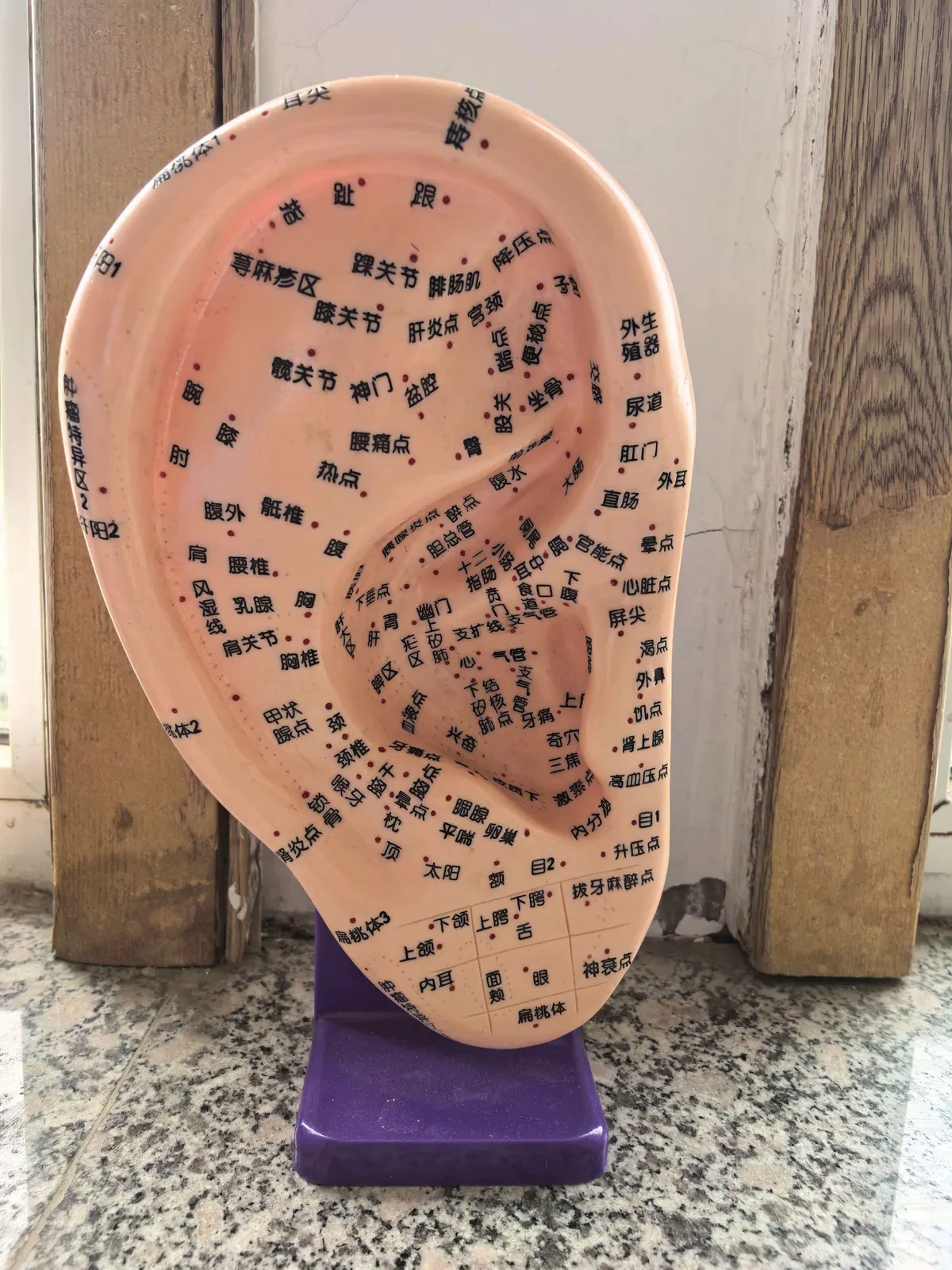
Point 4: Ear Shenmen (TF4) — On the Ear
The ear contains a micro-map of the body in both TCM and modern auricular therapy traditions. Ear Shenmen (TF4) is located in the triangular fossa — the small triangular depression in the upper part of the ear — and is one of the most frequently used auricular points for calming and relaxation.
How to Find It
- Look at your outer ear. Find the triangular depression near the top, just below the upper rim.
- Gently probe this area with your fingertip. The most tender spot is usually Ear Shenmen.
How to Press
- Use the tip of your index finger or a cotton swab.
- Apply gentle pressure — the ear is sensitive, so use less force than on other points.
- Hold for 30 to 60 seconds on each ear.
- Some people find a light circular massage of the entire ear is more practical than isolating one point.
Ear acupressure is particularly useful in situations where discreet self-care is helpful — at work, on public transport, or in any setting where pressing your wrist or forehead might draw unwanted attention.
Point 5: LI4 (Hegu) — On the Hand
Hegu (合谷), or Large Intestine 4 (LI4), is the fleshy mound on the back of the hand between the thumb and index finger. It is one of TCM's most versatile points — used for everything from headache to general stress relief. Its broad regulatory effect on qi flow makes it a useful addition to a calming routine.
Important Pregnancy Warning
LI4 is traditionally avoided during pregnancy. If you are pregnant, skip this point and use the other four instead.
How to Find It
- Look at the back of your hand. Find the highest point of the muscle between your thumb and index finger.
- Bring thumb and index finger together to make the muscle bulge.
- LI4 is in the center of that bulge, slightly closer to the index finger bone.
How to Press
- Use the thumb of your opposite hand.
- Apply firm, steady pressure into the fleshy mound.
- Hold for 1 to 2 minutes. Switch hands.
- The sensation is often deeper and more diffuse than at other points — this is normal.
A 5-Minute Calming Routine
When you notice tension building, try this simple sequence:
- Yintang (1 minute). Sit comfortably. Close your eyes. Press gently between your eyebrows. Breathe.
- HT7 (1 minute per wrist). Press the inner wrist point on each side. Let your shoulders drop with each exhale.
- PC6 (1 minute per arm). Press between the two tendons on your forearm. Take slow, deep breaths.
- Ear Shenmen (30 seconds per ear). Gently press the tender spot in the upper ear.
- LI4 (1 minute per hand). If not pregnant, finish with firm pressure on the hand point.
Five minutes total. If five minutes feels impossible in the moment, just do one point — Yintang with your eyes closed. The goal is not to perform a complete routine. The goal is to interrupt the stress cycle for long enough that your body remembers it can relax.
When to Seek Professional Support
Acupressure is a comfort practice. It cannot treat anxiety disorders, panic attacks, depression, trauma, or any mental health condition.
Please seek professional support if:
- Anxiety, worry, or panic interferes with your work, relationships, or daily life
- You avoid situations because of fear or anxiety
- You experience sudden episodes of intense fear with physical symptoms (racing heart, chest pain, shortness of breath, dizziness)
- You feel persistently sad, hopeless, or uninterested in things you used to enjoy
- You use alcohol or substances to manage your mood
- You have thoughts of self-harm
If you may harm yourself or someone else, contact emergency services or a crisis line immediately.
These situations deserve professional care. Self-care can support recovery — it cannot take the place of it.
Want More Like This?
The book Chinese Wellness Self-Care includes gentle acupressure routines, five points with detailed instructions, and a seven-day starter plan. It is written for general wellness education only.
Learn more: /book/
Disclaimer
This article is for general wellness education only. It does not diagnose, treat, cure, or prevent anxiety, depression, panic disorder, PTSD, or any mental health or medical condition. It is not a substitute for professional medical advice, mental health diagnosis, therapy, or treatment. If you have persistent anxiety, panic attacks, or emotional distress, please consult a qualified mental health professional.
Editorial Source Notes
- Acupressure point locations and traditional functions are based on standard TCM texts and presented here for educational purposes only.
- HT7 (Shenmen) and Yintang (EX-HN3) are among the most commonly cited acupressure points in clinical literature examining complementary approaches for stress and relaxation.
- Ear Shenmen (TF4) is widely used in auricular therapy traditions and has been studied in clinical settings for its calming properties.
- NIMH resources distinguish between everyday stress, anxious feelings, and clinical anxiety disorders that require professional diagnosis and treatment.
- NCCIH guidance notes that mind-body practices may support general wellness but are not substitutes for medical or mental health care.